Resources·Getting real work out of AI agents: start with your Kanban
Getting real work out of AI agents: start with your Kanban
A single AI agent is impressive in a demo. It drafts, searches, summarises, sorts, follows up. Then it vanishes into a tab, a conversation, a history nobody reads again. The work may well have advanced — but the team no longer knows where it stands, why, or who signs it off.
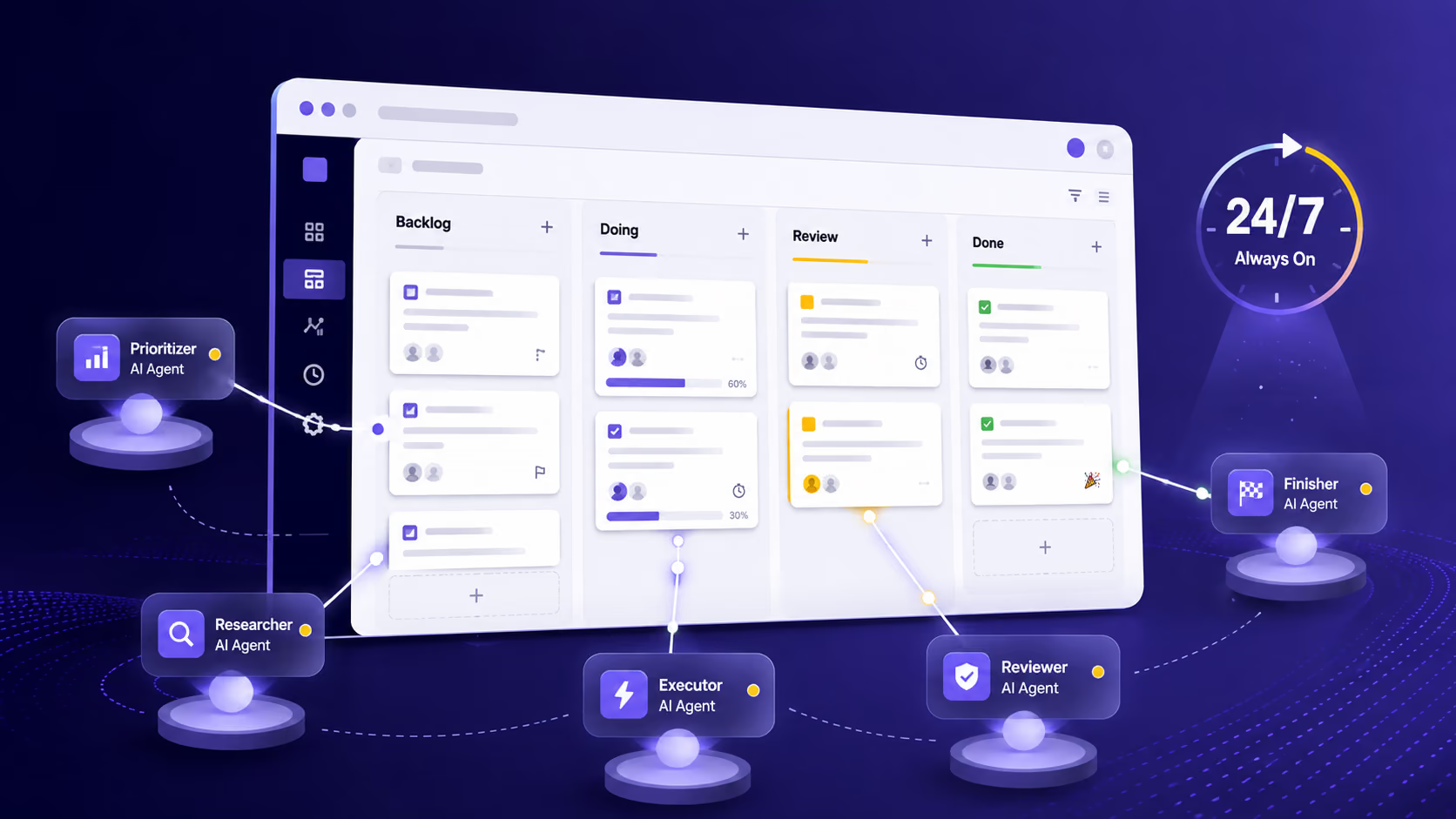
The gain starts when the agent enters the company's actual system of work. For most teams that system is not a large piece of software. It is a Kanban board: a column for what is waiting, one for what is in progress, one for review, one for what is done.
If you want to be productive with several AI agents, start there. Not with a fleet of autonomous agents. With a board where each agent picks up a clear task, leaves a usable trace, and hands back to a human when the decision matters.
Why does a lone agent create disorder so quickly?
An AI agent works fast, but speed is not legibility. Without a frame, it produces three very concrete problems.
The first is scatter. One request goes into ChatGPT, another into Claude, a third into a line-of-business tool. By the end of the day nobody has a simple view of what is finished, blocked, or waiting for approval.
The second is blurred responsibility. If an agent sends a client reply, who reviewed it? If an agent edits a CRM record, who owns the mistake? If an agent prepares a quote, who decided the price was right?
The third is the absence of measurement. A team can feel like it used AI all day without knowing whether it actually saved any time. A Kanban settles this, because it turns AI usage into a visible flow: cards in, cards handled, cards rejected, cards sent back.
Why is Kanban the right format for several agents?
Kanban has a rare quality: simple enough to understand in five minutes, strict enough to prevent chaos. That is exactly what you need when several agents touch the same flow.
One agent can qualify incoming requests. Another can hunt down the missing information. A third can draft a first version. A fourth can check consistency, flag risks, or prepare a summary for the manager.
What matters is not the number of agents. What matters is the rule for moving between columns.
A simple Kanban flow for AI agents
- 1To qualifyThe agent sorts, names the task and checks what information is available.
- 2To produceThe agent runs one precise mission with an imposed output format.
- 3To checkA second agent looks for errors, omissions and sensitive points.
- 4To approveA human decides, corrects, or sends it back for another pass.
- 5DoneThe final output is archived with whatever reasoning is worth keeping.
In this model the agent does not own the process. It takes a card, applies an instruction, writes the result, then moves the card where it belongs. Less spectacular than a fully autonomous end-to-end automation — and considerably more robust.
What does 24/7 actually mean inside a company?
A 24/7 system does not mean the company lets AI decide on its own at three in the morning. It means work can advance outside office hours where the risk is low and the rules are written down.
An agent can prepare replies to requests that arrived in the evening. It can file attachments, spot missing information, enrich a record, produce a draft and drop it into review. In the morning the team does not find a full inbox. It finds a queue of cards already prepared.
The distinction matters. The AI runs around the clock. Human approval stays wherever the client relationship, the price, the legal position, compliance or the company's reputation is on the line.
The placement test is not how hard the task is — it is how reversible it is. A task you can redo with no consequence can run overnight. A task that leaves the company waits for a person.
| Stage | The agent may | The human decides |
|---|---|---|
| Sorting | Categorise, date | Nothing |
| Research | Pull the history | Contradictory sources |
| Draft | Write to the format | Tone on a sensitive file |
| Check | Flag gaps, omissions | Rules that collide |
| Send | Prepare | Price, commitment, image |
This table is not a measurement, it is a design rule: give agents the zones where they cut waiting time, and keep irreversible decisions at the right human level.
What should one card produce?
Plenty of teams ask an agent for far too much in a single instruction. "Analyse this file, find the problems, write to the client, update the CRM and prepare the follow-up." That is a recipe for a long answer that is hard to check and impossible to measure.
In a multi-agent Kanban, every card has to produce a checkable result:
- Qualify a request: category, urgency, missing documents, next action.
- Summarise a file: five key points, risks, open questions.
- Draft a reply: a draft ready to review, right tone, internal sources cited.
- Check an output: likely errors, inconsistencies, facts to confirm.
- Prepare a follow-up: recipient, context, short message, proposed date.
A clear card protects the team. It also protects the agent, because it stops it pretending to command a whole process when it should only handle one step.
How do you start without building a factory?
A good start comes down to four decisions.
Pick one flow. Not the whole company. An inbound request queue, quotes, meeting notes, follow-ups, or a weekly report. If the flow is not already visible today, write it down before automating it. If you are unsure which candidate to take first, our inventory of five processes an SME can automate this month lists the tasks that come up most often in our workshops.
Define the columns. The names can stay plain: To sort, In progress, AI review, Human approval, Done. The vocabulary has to make sense to the team, not only to whoever configured the tool.
Create the agent roles. One agent searches. One drafts. One checks. One prepares the summary. The narrower the role, the higher the quality.
Write the exit rule. A card does not move to the next column because the agent replied. It moves because the expected result is there, in the right format.
A five-day rollout
- 1Day 1Map one real flow with the people who actually handle it.
- 2Day 2Write the columns, the transition rules and the output formats.
- 3Day 3Build two or three specialised agents, no more.
- 4Day 4Test on ten real cards and log every rework needed.
- 5Day 5Measure the time saved and decide whether the flow deserves to grow.
Which mistakes break the productivity?
The first mistake is granting broad access too early. An agent that can read, write, send and edit with no checkpoint will save time on day one and create debt on day two.
The second is confusing automation with the disappearance of work. The work does not disappear. It changes shape: less data entry, more review, more deciding, more designing instructions.
The third is failing to name the exceptions. Every company has cases where the AI must stop: a sensitive client, a large amount, personal data, a legal document, a commercial promise, an uncertain fact. Those exceptions belong on the card, visibly.
The fourth is adding agents before fixing the flow. If two agents produce mediocre results, four agents will usually produce four mediocre results that are harder to track.
When an AI Kanban is the wrong answer
There are situations where this system costs more than it returns, and it is better said before you start.
If the process does not exist yet, AI will not invent it. A flow that three people each handle their own way does not need agents; it needs a decision about how the work is done. Automating a disagreement only makes it faster.
If the volume is low, the arithmetic does not work. Five cards a week do not justify writing instructions, testing them and maintaining them. Design time exceeds time saved, sometimes for a long while.
If the data is scattered or wrong, start there. An agent reading an incomplete CRM produces outputs that are plausible and wrong — worse than no output at all, because nobody checks those twice.
Finally, if the task calls for judgement the company has never written down — what counts as a good client, when to grant a discount, which promise is deliverable — the agent has nothing to imitate. Those rules get settled between people first, and only then become instructions.
What should a team measure?
A useful AI Kanban is measured with plain indicators. How many cards arrive each week? How many are prepared by agents? How many come back for rework? How many are approved without heavy correction? How long passes between arrival and approval?
Those numbers do not need to be perfect. They only need to be steady enough to answer one question: is the system making the team faster without making the work more fragile?
If the answer is no, narrow the scope. If the answer is yes, you can add a second flow, then a third. It is slower than a big internal announcement, but it is how a practice holds.
Where to start with AI Magic Makers
At AI Magic Makers we do not sell AI agents as a separate service line. We use them as a concrete outcome of a workshop, an audit or an integration engagement: a real process, broken down, measured, then improved.
If your team wants to learn to build this kind of flow, the entry point is an AI workshop. We start from a board you already have, or a process you still handle by hand, and turn a few cards into agent-assisted tasks.
If several teams are involved, start with an AI audit instead. In five days we identify the flows that would genuinely benefit from a multi-agent Kanban, the ones that should stay manual, and the ones that need their data cleaned up first.
The best system is not the one where agents do the most work. It is the one where the team always knows what is moving, what is stuck, and what a human has to decide.