Resources·AI for SMEs in Morocco in 2026: where to start, what to automate, what budget
AI for SMEs in Morocco in 2026: where to start, what to automate, what budget

An SME in Morocco gets value from AI by starting small: three frequent tasks, a team trained on its own files, and data classified before any tool is chosen. Licences come later, once the time recovered has been measured. That is the order we follow at AI Magic Makers, in audits and in training. For advanced management technology, the World Bank's 2024 survey finds that adoption alone produces no significant gain.
Key takeaways
- In Morocco, 4.3% of formal establishments with 5 or more employees use Big Data or AI (World Bank, 2024 survey, reported in October 2026).
- For advanced management technology, the World Bank observes that gains come from intensive use, not from adoption alone.
- Start with three frequent, measurable tasks and with your team's skills, before buying any software.
- Classify your data into four levels before choosing a tool. Once an AI system processes personal data, Law 09-08 applies, as the CNDP, Morocco's data protection authority, has pointed out.
- The budget follows the time recovered. The OFPPT's special training contracts (CSF) can cover part of your team's training.
Where do Moroccan companies stand with AI in 2026?
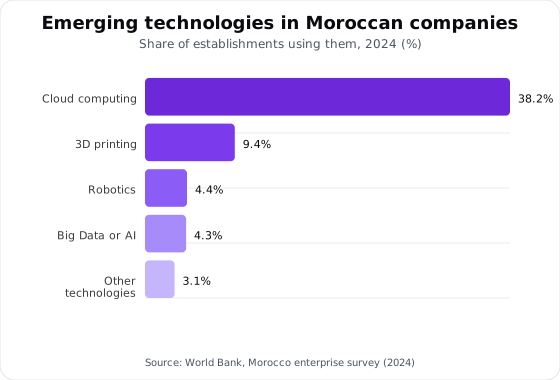
AI is still marginal in Moroccan companies: 4.3% of establishments use Big Data or AI. The figure comes from a World Bank survey carried out in Morocco in 2024. The sample represents formal establishments in industry and services with 5 or more employees. The results appear in a regional report on the MENAAP region, reported by Aujourd'hui le Maroc on 7 October 2026.
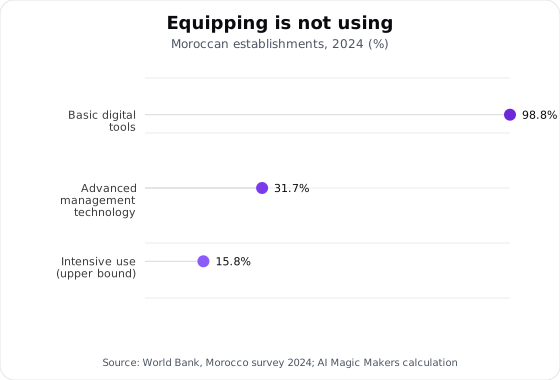
The digital basics, on the other hand, are almost universal. According to the World Bank's 2024 survey, 98.8% of establishments have basic digital tools. Among emerging technologies, cloud computing reaches 38.2%, 3D printing 9.4%, robotics 4.4% and other technologies 3.1%.
For context, Eurostat reported on 11 December 2025 that 20.0% of EU enterprises with 10 or more employees used AI in 2025. The comparison is only approximate. The scopes differ: 5 or more employees on one side, 10 or more on the other, and "Big Data or AI" versus "AI" alone.
Why isn't buying an AI tool enough?
Because equipment alone does not produce a measurable gain. For advanced management technology, the World Bank's 2024 survey finds that productivity gains only become significant with intensive use. Adoption alone gives no statistically significant gain. That is why training your team on its own files comes before buying new software.
And intensive use is rare. Nearly a third of establishments (31.7%) have adopted advanced management technology, such as specialised software or an ERP. Fewer than half of them use it intensively. By our calculation, that is less than 16% of all establishments.
These figures cover management software, not AI. Our working assumption is that AI follows the same pattern. Take an illustrative scenario: management buys AI assistant licences for the whole team. Three months later, one or two people use it to rephrase emails, and the rest have forgotten it.
Nobody defined which task the tool was for, or how to measure whether it helped. Equipping is not the same as using. An unused licence costs its price and returns nothing. What turns a tool into a gain is a team that knows how to apply it to its quotes, letters and files, every week.
Which tasks can an SME in Morocco hand to AI today?
The best candidates are frequent text tasks that start from a template or an existing document. An AI assistant such as ChatGPT or Claude is enough for drafting. Make or n8n then connect that assistant to your other tools to automate a full workflow. The table gives typical examples, not client results, using tools available at the time of writing.
| Task | Tool | Data involved | What to check |
|---|---|---|---|
| Drafting quotes and sales proposals from a template | ChatGPT or Claude | Internal | Prices, discounts and terms, always taken from your price list |
| Customer follow-ups and prepared WhatsApp Business replies | Make or n8n, with a language model | Personal | A person approves every message before it goes out |
| Meeting minutes | ChatGPT or Claude, from notes or a transcript | Internal, sometimes confidential | Decisions, owners and deadlines; participants' consent to recording |
| Administrative letters in French and Arabic | ChatGPT or Claude | Internal or personal | References, dates and official wording, proofread by someone fluent in the language |
| Extracting supplier invoice data into a spreadsheet | Make or n8n, with a language model | Internal | Amounts before and after VAT, ICE (company identifier), spot checks on a sample |
| Monitoring tenders and first reading of tender specifications | Claude or ChatGPT | Public | Deadlines, required documents and elimination criteria, checked against the source document |
The "Data involved" column decides which tool is allowed, before any time saving. And a language model produces plausible text, not verified text: responsibility stays with a person.
These automations are not a product we sell separately. They are the outcome of a training or an audit: your team builds them on its own files, with us, and knows how to maintain them afterwards.

When is AI the wrong answer?
AI is the wrong answer when a mistake costs more than the time saved. We say so in an audit when that is the case. Here are five situations where we advise against automating.
- Figures and facts nobody can check. A model can invent a reference, a legal article or an amount. If nobody has time to review, automation moves the risk instead of reducing it.
- Decisions about people. Screening job applications or granting credit affects people's rights. The CNDP stresses that automated decisions must be open to challenge (see the data protection section).
- Processes that change every week. Automating an unstable procedure means rebuilding the automation constantly. Stabilise the process first.
- Tasks done twice a month. The setup time is unlikely to pay back. A good document template is enough.
- Data that cannot leave without safeguards. Medical records, HR data, trade secrets: without contractual and technical safeguards, they do not go into a consumer tool.
Want to know whether a specific task is worth automating? Ask us on WhatsApp and we answer with a yes, a no or a question.
How do you protect your company's data when using AI?
Decide which data may go into an AI tool before you choose the tool. Three things are enough to get started: the framework of Law 09-08, a four-level classification of your data, and three usage rules for your team.
What Law 09-08 says
Law 09-08 applies as soon as an AI system processes personal data. The CNDP restated this in a press release on 18 March 2025. Le360 summarised it on 26 March 2026, in a press review of Les Inspirations Éco: "Once they rely on personal data, they fall fully under Law 09-08" (our translation from French).
According to Le360, the CNDP restates the principles of transparency, fairness, specified purpose, proportionality and security. It also stresses "the contestability of automated decisions" (our translation), meaning the ability to challenge a decision made by a system. Le360 adds that the initiative is preparing "a reference framework specific to artificial intelligence" (our translation).
Until that framework is in force, the current law is enough to set sensible precautions for an SME.

Classify your data into four levels
Classification answers one simple question: can this information leave the company, and in which tool? Do it task by task, using the "Data involved" column from the task table.
| Level | Examples | Possible tool |
|---|---|---|
| Public | Website, catalogue, published product sheets | Any tool, including consumer tools |
| Internal | Procedures, document templates, internal memos | Business plan with a contractual framework |
| Personal | Customer files, employee data | Anonymise, or use a properly configured business subscription; processing declared to the CNDP, or authorised, as Law 09-08 requires |
| Confidential | Medical records, trade secrets, sensitive HR data | Local AI integration: open-source models, data on your own infrastructure |
"Consumer" here means a free or individual plan with no business contract. For a business subscription, read its data usage terms when you sign.
Three practical rules
- Anonymise before you test. Replace names, numbers and addresses with neutral placeholders. In training, we work on anonymised cases first, then on your own accounts with your IT lead.
- No personally identifiable data in a consumer tool. A customer file pasted into a free plan leaves your control, with no contract to govern it.
- Check your CNDP declaration. Any AI use that processes personal data must be covered by a CNDP declaration or authorisation. Keep an internal list of these uses: tool, purpose, categories of data.
This section is general information, not legal advice.
How do you start in four steps without wasting budget?
Start small and measured: three tasks, a diagnostic, a trained team, then a monthly measurement before you extend. Spending follows the time recovered, not the other way round.
Four steps for an SME
- 1Pick 3 tasksFrequent, measurable, data classified
- 2DiagnoseAI audit: 5 days, hours quantified
- 3Train the teamOn your real files
- 4Measure, then extendTime recovered, every month
1. Pick three tasks
List the tasks that come back every week, start from a template or a document, and can be timed as they stand today. Without a baseline duration, you will never know whether AI saved any time.
Then classify the data for each task: public, internal, personal or confidential. Start with tasks that involve no personal data, such as tender monitoring or quotes. Three tasks are enough to learn without spreading the team too thin.
2. Diagnose
If you don't know which tasks to pick, an AI audit does it for you. It is a 5-day diagnostic, from the first meeting to the final debrief. It maps your workflows, quantifies the recoverable hours process by process and prioritises 3 projects, with a 90-day rollout plan.
3. Train the team
The two-day in-house training takes up to 12 people and works on your real files. Teams leave with three automations in production, and management receives a report on the time gained.
If your leadership team needs to decide first, the half-day decision-makers' workshop runs at your premises or remotely, for up to 12 participants. For a single executive or a micro-business, the executive training brings together six participants from different companies.
4. Measure, then extend
Measure the time recovered on the three tasks every month. Only extend from what works. If you want support during this phase, AI consulting runs monthly or on a fixed scope.
What budget should an SME plan for in 2026?
The budget depends mostly on how many people you need to train and whether you need a diagnostic first. Here are our public prices at the time of writing. Tailored company offers are priced on quotation.
| Offer | Format | Price |
|---|---|---|
| Online AI training | 1 month, 8 live 2-hour sessions | 1,500 MAD per person |
| Executive training | 2 weeks, 20 hours hybrid, six seats | 4,100 MAD excl. VAT per person |
| Claude training for companies | Half a day to 2 days, up to 12 participants | 3,900 to 24,900 MAD excl. VAT per group |
| AI training for companies (in-house) | 2 days, 12 people maximum | Quoted after a scoping call |
| AI audit | 5-day diagnostic | On quotation |
| AI consulting | Monthly or fixed scope | On quotation |
On top of these amounts come the licences for the tools you choose. Their prices change: check them on the vendor's page when you decide, and only for the tasks selected in step 1.
In its 2024 survey, the World Bank notes that cost is the main obstacle cited by Moroccan companies. Funding exists for training. The OFPPT's special training contracts aim to "promote access for SMEs and SMIs, and even very small businesses" to continuing training (our translation from French).
Reimbursement is partial, according to the scale in force. For in-house training, we provide the documents for the CSF or OFPPT application.
Worked example
What follows is a simulation, not a result measured at a client. Take a team of 8 people who each recover 2 hours a week, over 45 working weeks: 8 × 2 × 45 = 720 hours a year.
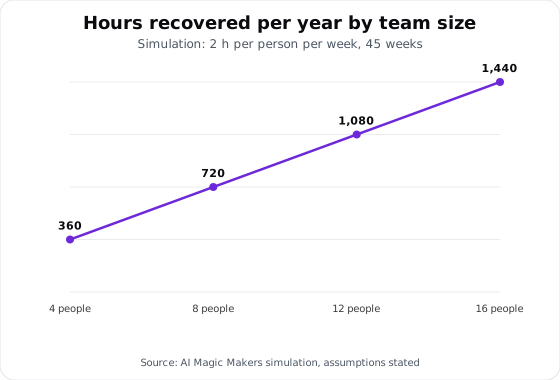
The line applies the same assumption to 4, 12 and 16 people. It is straight because the assumption is; in reality, not everyone saves the same amount of time.
To get a value in dirhams, multiply the hours by your fully loaded hourly cost. Then replace our assumptions with your own measurements, the ones from step 4.
Frequently asked questions
How do I use AI in my company without technical skills?
Start from your business, not from the tool. ChatGPT and Claude work in plain language, and Make or n8n can mostly be put together without code. The key skill is knowing how to check a result.
What does an AI audit for an SME actually do?
It tells you where to spend before you spend. The audit quantifies the recoverable hours process by process and ranks the projects by priority. It can also conclude that a task is not worth automating.
Can our customer data go into ChatGPT?
Not into the consumer version without safeguards. Personally identifiable data falls under Law 09-08. Anonymise it, use a properly configured business subscription, or keep it in-house with a local AI integration.
Which training should a team start with?
If management needs to decide first, start with the decision-makers' workshop. If the tasks are already identified, the in-house training trains the team on its own files. If you are torn between the two, the audit tells you where to start.
Book a scoping call: we look at your three candidate tasks and tell you whether an audit, a team training or nothing at all is the right next step.