Resources·AI training for companies: programme, exercises and ROI
AI training for companies: programme, exercises and ROI

An effective company AI training programme starts from the team's own processes, has people practise on their real files, and measures the hours recovered afterwards. At AI Magic Makers, in Morocco, an in-house training runs for two days with twelve people at most and ends with automations running in production. This guide covers the steps, the exercises, the ROI calculation, funding and the data rules.
Key takeaways
- A useful programme has four steps: scoping on your processes, practice on your files, going live, and measurement at 30 and 90 days.
- Exercises use real, timed tasks, not demonstrations.
- ROI = hours recovered × hourly cost, minus the training fee and the time spent in the room.
- Data security: anonymised cases in the room, then company accounts set up with your IT team. Law 09-08 applies as soon as an AI system processes personal data.
- In Morocco, OFPPT's special training contracts (CSF) can fund part of the cost, but few companies use them.
Why train your teams before buying licences?
Because the tool is not the main barrier. Eurostat surveys EU companies that considered AI but did not adopt it. In 2025, 70.9% named a lack of expertise first (Eurostat, data extracted December 2025).
The same source shows a sharp gap by company size. In 2025, 17% of small EU companies used at least one AI technology, against 55% of large ones. Large firms have data teams and training budgets; a small business has to train the people who already do the work.
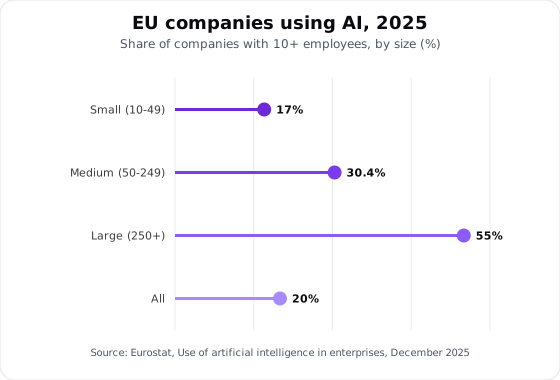
These are European figures and do not carry over to Morocco as they stand. They point to a pattern: without skills in-house, the licence goes unused. AI training for companies addresses that barrier directly, provided it works on the team's real tasks.
That is also what separates it from a generic course catalogue. A "discover generative AI" module shows what the tool can do. It does not show how your accounts team should prepare its payment reminders with it. For a project that spans several departments, our AI for companies page sets out the possible formats.
What should a company AI training programme include?
Four steps, in this order. If one is missing, the team leaves the room motivated and slips back into old habits within two weeks.
1. Scope on your processes
Before the session, each department lists the tasks that come back every week. For each one, write down the current duration and the type of data involved. That baseline is what the ROI is calculated from later. Without it, nobody can say whether the training worked.
2. Practise on your files
Practice takes most of the time. Each participant works on a task from their own list, using anonymised documents. The trainer corrects the prompts, shows where the tool goes wrong and has every output checked.
3. Go live
An exercise that works in the room is worth nothing if it is not running the following Monday. At AI Magic Makers, the two-day in-house training ends with three automations in production, on your accounts and with your access rights.
4. Measure at 30 and 90 days
Take the tasks timed during scoping and time them again. A useful gains report shows hours recovered per task and per team, plus the tasks dropped and why. Our in-house training delivers one to management.
Company AI training programme
- 1ScopeProcesses, tasks, data
- 2PractiseOn your real files
- 3Go liveYour accounts, your access
- 4MeasureHours recovered at day 30 and 90
Which exercises should a team do during the training?
A good exercise starts from a real task, produces something usable and states which data goes into the tool. The table gives typical examples, not client results. The tools named are those available at the time of writing.
| Exercise | Team | Output at the end | What to check on data |
|---|---|---|---|
| Draft invoice reminders from a template | Accounts | Three approved reminder templates | Client names, amounts: anonymise in the room |
| Summarise a contract and list its deadlines | Legal, purchasing | Two-page summary sheet | Confidential clauses: company account only |
| Produce structured meeting minutes | All | Reusable minutes template | Internal notes, low sensitivity |
| Sort and route incoming emails | Customer service | Sorting rules in Make or n8n | Client contact details: personal data, Law 09-08 |
| Write a job description or advert | HR | Advert ready to publish | Candidate data: never paste it into a consumer tool |
Every exercise ends with a human review. The AI writes a first draft; a person checks figures, names and tone before anything is sent. Hallucinations are part of the programme, not a footnote.
Some tasks do not deserve AI. A rare task with no template, or one that needs a binding legal judgement, stays with a person. We say so during the training.
Want to know whether a specific task is worth automating? Ask us on WhatsApp and we answer with a yes, a no or a question.
How do you protect company data during the training?
The main risk is not the training room. It is the day after, when a keen employee pastes a client contract into their personal ChatGPT account. The training therefore has to set the rules before the first exercise.

In Morocco, Law 09-08 governs the processing of personal data. The CNDP, Morocco's data protection authority, said so in a release of 18 March 2025, reported by Le360. AI systems "fall fully under Law 09-08" when they rely on personal data (Le360, 26 March 2026, our translation). This is information, not legal advice: your lawyer remains the judge of your obligations.
In practice, three rules are enough for the training:
- Anonymised cases in the room. Names, numbers and amounts are replaced before the session.
- Company accounts afterwards. Go-live exercises run on your accounts, set up with your IT team, retention and sharing settings included.
- A written list. What may go into an AI tool, what never does, and who decides when in doubt.
If your files cannot leave your servers, an online tool is not suitable, even on a business subscription. A local AI integration runs an open-source model on your own infrastructure, and the training then takes place on that tool.
How do you calculate the ROI of AI training?
With a simple formula, applied to the tasks timed during scoping:
ROI = hours recovered × loaded hourly cost − (training fee + hours spent in training × loaded hourly cost).
The participants' time in the room is a real cost and belongs in the calculation. Twelve people over two days come to about 168 working hours, assuming seven hours a day.
Here is a simulation, not a client result. Assumptions: twelve participants, a loaded hourly cost of 150 MAD and a fee of 24,900 MAD excl. VAT for the group. That fee is the price of our two-day Claude transformation pack at the time of writing. The total investment comes to 50,100 MAD.
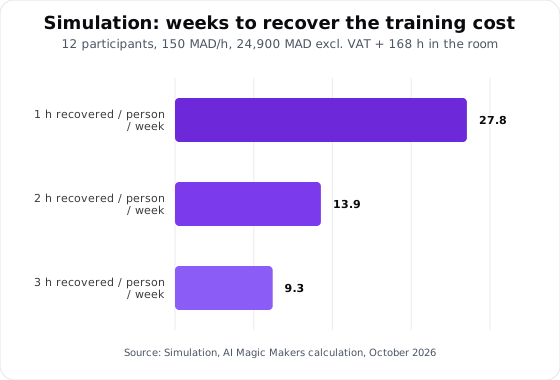
With one hour recovered per person per week, the training pays for itself in about 28 weeks. With two hours, in 14 weeks. With three hours, in just over 9 weeks.
The result depends entirely on the hours-recovered assumption. That is why measuring at 30 and 90 days matters more than any promise. If your team's tasks cannot free up one hour a week, the training will not pay off, and it is better to know that beforehand.
To get those hours before you sign, an AI audit quantifies the recoverable tasks, process by process, in five days. The training then focuses on the tasks that pay back most.
How can you fund AI training in Morocco?
Through the special training contracts (CSF) run by OFPPT, Morocco's vocational training office. An eligible company obtains an access certificate, then files its reimbursement claim by 31 December of year N+1 (OFPPT, CSF page). Access requests for year N open from October of year N-1.
The scheme is little used. In its opinion on continuing training in the private sector, the Economic, Social and Environmental Council (CESE) notes that in 2022 only 1,647 companies used CSF. Nearly 315,000 companies paid into the system, so about 0.5% (Hespress, 3 June 2026).
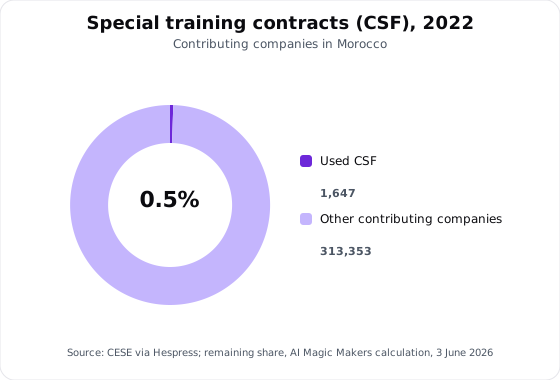
OFPPT does not publish a coverage rate on that page, so we do not quote one. Check with the CSF management unit before you set your budget. For our in-house training, we supply the documents for the CSF or OFPPT file, depending on your situation.
Plan the calendar early. If the access request has to come before the training, a session planned for January needs preparing the previous autumn.
Which format suits your company?
The format depends on who has to decide and who has to practise. Here are our formats, with public prices at the time of writing:
| Format | Who it is for | Duration | Price |
|---|---|---|---|
| Claude decision-makers workshop | Leadership team, up to 12 people | Half a day | 3,900 MAD excl. VAT per group |
| Claude transformation pack | One team, up to 12 people | 2 days | 24,900 MAD excl. VAT per group |
| AI training for companies | One team, up to 12 people | 2 days | Quoted on scope |
| AI for executives | Leaders from several companies, 6 seats | 20 hours over two weeks | 4,100 MAD excl. VAT per person |
If your leadership has not yet chosen which departments to train, start with the decision-makers workshop or the audit. If one team is already waiting, go straight to the two-day training on its own files. The workshops catalogue also lists the sessions open to individuals.
Frequently asked questions
What does a company AI training programme include?
Scoping on your processes, practice on your anonymised files, going live on your accounts, and measurement of hours recovered at 30 and 90 days. Data rules are part of the programme from day one.
How long does AI training for a team take?
At AI Magic Makers, from half a day for a leadership team to two days for a team that puts automations into production. Then measure the hours recovered at 30 and 90 days.
How do you train employees on AI without exposing client data?
By working on anonymised cases in the room, then on company accounts set up with your IT team. Data that cannot leave your servers goes through a model hosted in-house.
Can OFPPT fund AI training?
Yes, through special training contracts (CSF), if the company is eligible and files on time. Check the coverage rate with OFPPT before you budget.
Want a programme built on your team's own processes? Book a scoping call: we set the scope, the date and the quote together.