Resources·AI Automation ROI: Calculation Method, Excel Model and Practical Examples
AI Automation ROI: Calculation Method, Excel Model and Practical Examples


Calculating the return on investment of AI automation in Morocco requires a disciplined method. We multiply actual hours saved by the fully loaded hourly cost, then deduct software and maintenance expenses. At AI Magic Makers, our methodology rejects guesswork in favor of observed volumes and conservative assumptions. A well-scoped automation initiative reaches its financial break-even point between two and six months.
Key takeaways
- The ROI formula compares net annual savings against the total upfront capital expenditure.
- Fully loaded hourly cost in Morocco includes gross salary, mandatory CNSS, AMO health coverage, and overhead.
- A disciplined Excel model incorporates a 20% safety margin to absorb complex document exceptions.
- Automated workflows processing personal data require prior declaration with Morocco's CNDP under Law 09-08.
- An initial diagnostic audit isolates two or three high-yield processes before committing engineering resources.
Why calculate return on investment before launching an automation project?
Enthusiasm for artificial intelligence can lead executives to fund initiatives without financial scoping. In Moroccan small and medium-sized enterprises, capital and staff capacity are strictly constrained. Committing funds based on intuition produces predictable disappointments. Companies face forgotten software subscriptions, broken pipelines, and unexpectedly high manual review overhead.
Quantifying expected returns replaces hopeful assumptions with disciplined business logic. The calculation exercise requires department leaders to inspect their actual day-to-day operations. How many supplier invoices does the accounting desk process each week? How many hours do sales reps spend transferring contact details from WhatsApp into an ERP database? What clerical errors cause customer disputes and delayed payments?
During our 5-day AI diagnostic audits, we observe that managers overestimate time spent on high-visibility tasks. At the same time, they ignore hidden productivity leaks caused by manual rekeying. An upfront financial model compares anticipated deployment costs with the real expense of staying manual. It also establishes clear performance benchmarks that the leadership team tracks once the automated workflows enter production.

What mathematical formula measures AI automation ROI?
Measuring financial returns involves much more than comparing tool license fees. To obtain a defensible business metric, the calculation accounts for four distinct variables.
The first variable quantifies gross labor savings. You calculate this figure by multiplying recurring hours recovered each month by the employee's fully loaded hourly cost. In Morocco, an employee earning a net monthly salary of 8,000 MAD represents an employer cost of approximately 11,500 MAD. This figure includes CNSS social contributions, AMO mandatory medical coverage, workplace insurance, and accrued paid leave. Across the standard legal baseline of 176 monthly working hours, the loaded hourly rate stands at 65.34 MAD. If an automated script saves that employee 30 hours each month, gross labor savings equal 1,960 MAD monthly.
The second variable values operational error reduction. Manual data entry processes generate an error rate between 2% and 5%. Every incorrect invoice line, credit memo, or shipping error triggers costly administrative rework. Monthly error savings equal the number of avoided errors multiplied by the average cost of resolving each incident.
The third variable consolidates the total cost of ownership. This expenditure includes initial system configuration fees, annual software subscriptions, and ongoing technical maintenance.
The fourth variable deducts remaining human supervisory time. Generative AI models require human validation on borderline cases. If an operator spends five hours per month reviewing low-confidence outputs, those hours must be subtracted from total monthly savings.
The consolidated financial formula is structured as follows:
Net annual savings equal twelve times monthly gross savings minus recurring operating fees, from which we subtract the upfront capital expenditure. The percentage ROI is calculated by dividing net annual savings by initial investment, multiplied by one hundred.
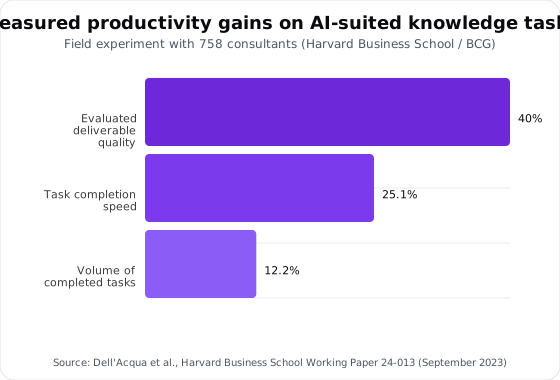
A landmark field experiment by Harvard Business School and BCG researchers (Dell'Acqua et al., 2023) involving 758 professional consultants demonstrated that performance gains depend heavily on proper task selection. On tasks well aligned with generative models, consultants improved their execution speed by 25.1%. They also finished 12.2% more tasks, while increasing evaluated work quality by 40%. Conversely, when participants applied models to problems outside the technology boundary, error rates rose by 19 percentage points among untrained users.
How should you structure your Excel calculation model?
Constructing an actionable financial model requires four connected worksheets. This modular structure lets you evaluate sensitivity scenarios without breaking core formulas.
The first worksheet documents enterprise workforce baselines. You enter relevant job profiles, their gross monthly salaries, and the applicable employer social contribution rate in Morocco. This rate typically ranges from 20% to 25% depending on complementary coverage and managerial tier. The sheet automatically computes the loaded hourly wage for every operational role.
The second worksheet maps the targeted business process. For each sequential task, you record execution frequency, average transaction volume, and baseline processing minutes before automation. You also document estimated residual minutes after implementation. Here we apply an essential risk management practice: always include a 20% safety buffer to account for illegible scans, missing inputs, and manual exception routing.
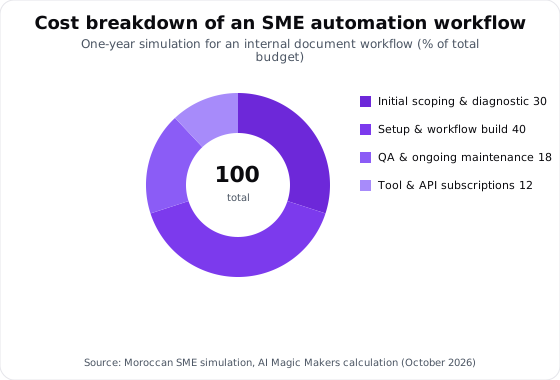
The third worksheet tallies project investments and recurring overhead. It separates one-time implementation outlays, such as audit and workflow configuration, from ongoing operational fees like platform subscriptions and hosting maintenance.
The fourth worksheet delivers the executive multi-year synthesis. It projects net monthly cash flow over 24 months, computes the exact break-even timeline in months, and presents annualized internal rates of return. This summary clearly shows the exact milestone when accumulated operational gains surpass total project expenditure.
What real-world gains appear across three typical SME workflows?
To illustrate how this calculation framework functions in practice, let us examine three realistic scenarios adapted to the Moroccan commercial sector. The figures detailed below reflect standardized simulations built according to our assessment criteria.
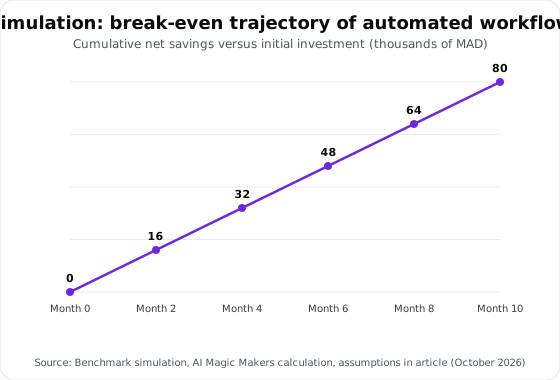
In a wholesale distribution company in Tangier, the finance desk processes 450 supplier invoices each month arriving in varied formats. Two administrative clerks previously dedicated 50 combined monthly hours to manually keying line items, VAT rates, and corporate tax numbers (ICE) into their accounting database. Implementing an automated extraction pipeline with human review reduced recurring manual time to 10 hours monthly. The 40 hours saved, valued at a loaded hourly cost of 70 MAD, represents 2,800 MAD in direct monthly labor recovery. Factoring in reduced supplier disputes, net monthly savings reach 3,400 MAD after deducting software costs. The upfront 16,000 MAD configuration budget achieved complete payback in 4.7 months.
In a Casablanca corporate services agency, three sales representatives received 200 inbound prospect inquiries each month across web forms and messaging channels. Initial lead triage, background checks, and qualification consumed 35 hours per representative monthly. Deploying an automated qualification and enrichment flow saved 25 hours per salesperson monthly. The team redirected these recovered hours into customer presentations, raising lead conversion rates without adding headcount.
In a specialized consulting practice, drafting audit summaries and synthesizing supporting financial documents required 30 hours per month from a senior consultant billed at 3,000 MAD per day. Automating document pre-formatting recovered 18 hours monthly, immediately freeing high-value billable capacity.
The following comparative table summarizes the financial metrics of these three benchmark workflows:
| Operational Parameter | Invoice Reconciliation (Trade) | Lead Qualification (Services) | Report Drafting (Consulting) |
|---|---|---|---|
| Monthly hours before automation | 50 hours | 105 hours (3 reps) | 30 hours |
| Residual monthly review hours | 10 hours | 30 hours | 12 hours |
| Net recovered hours per month | 40 hours | 75 hours | 18 hours |
| Fully loaded average hourly rate | 70 MAD | 95 MAD | 220 MAD |
| Monthly gross labor savings | 2,800 MAD | 7,125 MAD | 3,960 MAD |
| Error prevention & added value | 900 MAD | 4,500 MAD (conversions) | 1,500 MAD |
| Monthly recurring tool & API costs | 300 MAD | 750 MAD | 450 MAD |
| Net monthly recurring savings | 3,400 MAD | 10,875 MAD | 5,010 MAD |
| Initial implementation budget | 16,000 MAD | 38,000 MAD | 22,000 MAD |
| Observed payback period | 4.7 months | 3.5 months | 4.4 months |
| 12-month net project ROI | 155% | 243% | 173% |
Wondering whether a specific workflow is worth automating? Message us on WhatsApp to get a direct assessment.
What four-stage process validates automation viability?
To protect capital and guarantee positive cash flow before expanding software automation across an entire enterprise, we apply a disciplined four-stage evaluation methodology.
Four-stage automation scoping and validation framework
- 1Stage 1 · AuditMeasuring actual operational volumes and pinpointing workflow bottlenecks
- 2Stage 2 · ModelingBuilding conservative projections in Excel with safety buffers
- 3Stage 3 · PilotRunning automated pipelines on a controlled 15-day sample subset
- 4Stage 4 · Day-30 ReviewAuditing recovered hours and deciding on full organizational rollout
The first stage observes actual work patterns across a typical business week. Practitioners record task durations and catalog document formats. This qualitative inspection uncovers hidden friction points that drag down staff productivity.
The second stage inputs verified operational metrics into the financial model. We apply prudent labor recovery assumptions and an explicit safety margin for irregular transactions. If projected payback exceeds nine months, the project scope is reworked or paused.
The third stage deploys a working pilot across a limited transaction sample, typically 10% of total volume. This phase tests webhook stability, error handling, and model extraction accuracy on real files.
The fourth stage audits production performance after 30 calendar days. We contrast actual recovered hours against initial spreadsheet forecasts. This is also the inflection point where companies choose to build internal capability through structured AI training for companies. Training internal personnel enables your staff to supervise, troubleshoot, and evolve their own automated routines rather than paying continuous external agency retainers for minor adjustments.
What data security risks affect automated business workflows?
Automating administrative processes requires routing operational business information through scripts, cloud platforms, and model endpoints. Without strict technical safeguards, financial gains can be quickly erased by data leaks or regulatory enforcement.
The primary exposure involves commercial confidentiality. When an automation pipeline parses supplier bills, client quotes, or internal payroll files through public model interfaces, documents reveal strategic trade secrets: corporate tax identifiers (ICE), vendor pricing formulas, gross margins, and customer contact rosters. If third-party platform terms permit training on user inputs, the enterprise forfeits legal control over confidential assets.
The second vulnerability concerns statutory data privacy compliance in Morocco. National Law 09-08 establishes strict regulations for entities processing personal data, including customer names, phone numbers, home addresses, and banking coordinates. Automated data transfers and processing routines require prior declaration or formal authorization from the National Commission for the Control of Personal Data Protection (CNDP). Transferring personal data to uncertified foreign cloud servers without formal safeguards exposes businesses to legal liability and financial penalties.
Whenever automated workflows handle sensitive commercial agreements or protected personal records, we recommend deploying a local AI integration. Self-hosted open-source language models run on the client's own private infrastructure or in-country sovereign private clouds, ensuring that no sensitive records ever leave the corporate perimeter.

The following checklist highlights essential technical safeguards to mandate in your automation specifications:
| Targeted Workflow | Data Exposed | Operational Risk | Mandatory Protection Measure |
|---|---|---|---|
| Supplier invoice processing | Tax IDs, line items, bank accounts | Leaking confidential wholesale pricing terms | End-to-end API encryption and zero-data-retention clauses |
| Inbound prospect qualification | Customer names, mobile numbers, project briefs | Non-compliance with Moroccan Law 09-08 | Formal CNDP declaration and 90-day automatic data purge |
| Commercial contract analysis | Liability caps, non-compete clauses, trade secrets | Unauthorized exposure of strategic agreements | Self-hosted local AI deployed on private enterprise servers |
| Customer payment reminders | Outstanding balances, accounting details | Damaging client relationships via parsing bugs | Mandatory human approval gate before sending outgoing emails |
When should an enterprise avoid automating a process?
Achieving a healthy return on investment also means knowing when to say no. In everyday operations, software automation is not always the correct remedy. Three operational red flags should prompt leadership to pause or discard a proposal.
The first condition involves low-volume workflows. If a task takes only one hour every two weeks, configuration and maintenance will exceed cumulative savings across two full years. Automation requires sufficient transactional scale to offset fixed upfront engineering costs.
The second condition occurs when source inputs are unstructured or corrupted. If client records consist of irregular handwritten notes, varying paper receipts, or subjective appraisal criteria, language models will produce high error rates that force staff to recheck every transaction. Processes must be standardized manually before being automated.
The third condition concerns core strategic negotiations and sensitive client relationships. Handing contract adjustments or client dispute management entirely to an automated system introduces unforced commercial vulnerabilities. For these responsibilities, participating in hands-on AI workshops helps team members sharpen their personal skills without removing necessary human judgment from key commercial touchpoints.
A seminal NBER study (Brynjolfsson, Li & Raymond, 2023) analyzing more than 5,000 workers revealed that AI assistance delivers asymmetric productivity gains: novice and junior employees increased their output by 34%, whereas top-tier specialists improved only marginally. This empirical finding confirms that automation yields the highest financial return when assisting teams with repetitive administrative workloads, rather than attempting to replace irreplaceable managerial expertise.
To build an automation roadmap tailored to your specific organizational structure, our strategic consulting services evaluate your business departments to prioritize high-impact workflows across your company operations.
Frequently asked questions
What minimum budget is required to automate a first process in an SME?
For an initial document or administrative workflow, such as invoice parsing or web lead routing, startup budgets typically range between 15,000 and 25,000 MAD. This covers workflow diagnostics, integration setup, and initial team onboarding. Ongoing tool subscriptions generally average between 300 and 800 MAD per month depending on transaction volumes.
How quickly does an automation project become profitable in Morocco?
On well-scoped projects focused on high-volume repetitive tasks, payback timelines range between 3 and 6 months. Initiatives that take longer than nine months to break even usually suffer from excessive technical scope or insufficient monthly transaction volume.
Do we need an in-house software developer to manage these automated systems?
No. Modern visual automation platforms allow digitally proficient administrative and operational staff to maintain routine workflows, provided they receive structured hands-on training. External technical specialists are only required for complex custom database integrations.
How should automated workflows be declared with Morocco's CNDP?
If an automated system processes information identifying individuals, the company must submit a prior declaration to the CNDP under Law 09-08. This filing specifies the processing purpose, categories of data collected, storage duration, and technical security measures.
Ready to quantify your recovered hours and equip your teams? Book a scoping call to identify your top automation opportunities.